
Overall score
This checkup is for education only and is not investment advice, and your result is an approximation drawn from the ranges you chose and the stated assumptions.
Wealth Health Checkup
The free checkup scores your finances out of 100 across eight pillars in about three minutes. Every amount is chosen from a range, so you never need to share an exact figure.
You have a checkup in progress on this device. You can resume it or start again.
Your completed checkup is saved on this device. You can view your report again or start a new checkup.
Your checkup from this visit is still in progress. You can resume it or start again.
Your report from this visit is still open in this browser. You can view it again or start a new checkup.
The method
Each pillar compares your answers with a benchmark that Wealthier has set from widely used personal finance rules of thumb in India, and any pillar that does not apply to you is left out of the score.
Retirement and your portfolio carry the most weight, and gaps in reserves, protection and debt rank higher among your priorities.
Questions that do not apply to you are skipped automatically.
Six critical gaps, such as having no health insurance, limit the score so that one strength cannot hide a serious risk.
Each band, from Critical to Robust, comes with a plain summary of what it means for your household.
Private by design
The score is calculated on your device, and no answer is ever sent to Wealthier.
Questions
Any other question about the checkup can be sent to hello@wealthier.in.
The score is reliable for its purpose, which is to show where your finances stand and which pillar needs attention first. Each amount is chosen from a range, such as ₹50,000 to ₹75,000 a month, and the checkup scores it at a typical value within that range. An amount close to the edge of its range may be scored slightly high or low, so the score is a dependable guide to priorities rather than an exact measurement.
The checkup is an educational tool. It applies general rules of thumb to your answers and does not consider your complete financial situation, so it is not investment, tax or insurance advice, and a qualified professional can review any decision with you.
The checkup works only from your own answers and uses no credit bureau or other outside data. It covers your whole household, from cash reserves and insurance cover to retirement and the mix of your investments.
A critical gap, such as having no health insurance, always comes first. Any other pillar below 75% of its benchmark can become a priority, and these are ranked by the points they would add to your score, with cash reserves, insurance cover and debt weighted a little higher. The top three form your list.
The checkup works for both. Pillars that do not apply are left out and the remaining weights are scaled up, so students are not scored on life cover or retirement readiness, and retired households are not scored on life cover or the savings habit.
You can print the report or save it as a PDF, and the share option passes on only your score and its band. A fresh checkup once a year, or after a major event such as a new job, a marriage or a home loan, shows how each pillar has moved.
From score to next step
Your report lists up to three priorities in order of impact and links each one to a Wealthier feature or to a short explanation.
The report names no scheme, and every suggestion in it is general education.
Wealth Health Checkup report
Overall score
This checkup is for education only and is not investment advice, and your result is an approximation drawn from the ranges you chose and the stated assumptions.
Your band
Critical gaps
Closing the gaps listed here would lift the limit.
Eight pillars
Priorities
In order of impactSteps in the Wealthier app open the account sign up page.
Strengths
Retirement
The chart is illustrative and based on the stated assumptions. Returns are not guaranteed.
Full pillar detail
Method and disclaimers
The Wealthier Wealth Health Checkup scores eight pillars of household finances. Each pillar compares your answers with a benchmark that Wealthier has set from widely used personal finance rules of thumb in India, and the weighted results are combined into a score out of 100. These benchmarks are choices made for an educational score, and no regulator has set them. Pillars that do not apply, such as life cover for a household with no dependants, are left out and the remaining weights are scaled up. Where a critical gap exists, such as the absence of health insurance, the overall score is limited to 69 so that a strong result in one area does not hide a serious risk in another.
Key assumptions are inflation of 6% a year, a return of 10% a year on investments before retirement, regular investments rising by 5% a year, retirement at age 60 or three years from the current age for those aged 57 and above, and a retirement corpus equal to 30 times annual expenses at the time of retirement. For retired households, and for anyone aged 70 or above, investments are compared with current withdrawals over a horizon to age 90, or ten years if longer, without assuming further growth or inflation.
Benchmarks include emergency reserves of three to nine months of expenses depending on income stability, doubled where health cover has been declined; term life cover of 15 times annual income below age 40, 12 times between 40 and 49 and 5 times from age 50, adjusted for the dependants named; health cover of ₹5 lakh to ₹35 lakh depending on city, household and age; total EMIs of 20% of income after tax or less for full marks, with marks for EMIs reducing to zero at 60%, since many lenders treat about 40% to 50% as an upper limit; regular investing of at least 20% of income; and an equity share within ten percentage points of 100 minus age, with that reference point held between 20% and 80% and the middle of the chosen equity band compared against the resulting range.
Your age and every amount are chosen from ranges rather than entered exactly. Each range is scored at a typical value within it, close to its geometric middle, so that a range of ₹50,000 to ₹75,000 a month counts as about ₹61,000; an open range such as Below ₹15,000 counts at 60% of its limit, and an open range such as Above ₹5 lakh at 130% of its limit. The score and every figure in the report are therefore approximations, and a critical gap reflects what the ranges chosen indicate.
Scores and percentages are rounded to the nearest whole number, with halves rounded up. A full risk profile can be completed in the app after an account is opened. The checkup is designed for resident Indian households, and the benchmarks are reviewed periodically.
Methodology version 1.2, with range answers, 22 October 2026
The Wealthier Wealth Health Checkup is a free educational tool provided by Areion Wealthtech Private Limited. The score, report and suggested next steps are generated automatically from the information entered and from general personal finance rules of thumb used in India. The results do not take into account the complete financial situation, objectives, tax position or risk profile of any person, and do not constitute investment advice within the meaning of the SEBI (Investment Advisers) Regulations, 2013, or tax, legal or insurance advice.
Projections rely on the assumptions stated in the methodology, including inflation of 6% a year, a return of 10% a year before retirement and a retirement age of 60. These assumptions are illustrative only; actual inflation and returns will differ, and returns are not guaranteed. Benchmarks for emergency reserves, insurance cover and debt levels are general guides, and actual needs vary from household to household. Before acting on any part of the report, a review with a SEBI registered investment adviser, a qualified tax professional or a licensed insurance intermediary, as appropriate, is recommended.
Mutual Fund investments are subject to market risks, read all scheme related documents carefully. Answers are used to calculate the score within the browser, are stored on this device only when the option to remember answers is chosen, and are not sent to Wealthier, in line with the Wealthier privacy notice and the Digital Personal Data Protection (DPDP) Act, 2023.
Your answers are processed only within this browser to calculate the score and the report, and no answer is sent to Wealthier or to any other party. Answers are kept after this visit only when the option to remember answers on this device is ticked. In that case the answers are held in the local storage of this browser, under the name wealthier.checkup.v1, until you use Clear saved answers or untick the option, and either action deletes the stored answers at once.
The checkup does not ask for a name, a PAN, an Aadhaar number, bank details, contact details or any exact amount, and it is designed for adults aged 18 and above. The Wealthier privacy notice sets out the rights available under the DPDP Act, 2023, and questions can be sent to hello@wealthier.in.
Next steps
Goals, SIPs and holdings in the Wealthier app help you follow each step over time, and a SIP can start from ₹100 a month in many schemes.
Emergency Reserves
Life Protection
Health Protection
Debt and Credit
Savings Habit
Retirement Readiness
Portfolio Strength
Estate and Tax Readiness
Emergency Reserves measures the cash available for a sudden expense or a loss of income.
Life Protection measures whether term life cover would replace income for dependants.
Health Protection measures whether health insurance would meet hospital costs for the household.
Debt and Credit measures the share of income committed to EMIs and the quality of the credit record.
Savings Habit measures the share of income after tax that is invested regularly.
Retirement Readiness measures progress towards a corpus that can fund retirement expenses.
Portfolio Strength measures the balance of investments across equity, fixed income, gold, global markets and single holdings.
Estate and Tax Readiness measures nominations, a will, yearly tax reviews and the accessibility of records.
On track
Partly on track
Needs attention
Not scored
Critical gap
Your score is based on {count} of 8 pillars.
{count} of 8 pillars
One gap
{count} gaps
Your overall score is {score} out of 100, in the {band} band.
Prepared on {date} at {time} Indian Standard Time, from the answers chosen in this browser.
A Wealth Health Checkup on wealthier.in produced a score of {score} out of 100, in the {band} band.
A summary of your score has been copied, ready to paste.
The summary could not be copied in this browser.
Wealth Health Checkup
The saved answers have been deleted from this device.
Your finances are in the {band} band, with a score of {score} out of 100.
Your finances show strong foundations across protection, liquidity and long term growth. Emergency reserves, insurance cover and debt levels sit within widely used planning benchmarks, and current investing habits keep retirement and other goals on track under the assumptions used. The focus at this stage is refinement: keeping the asset mix aligned with age and goals, adding international or thematic exposure with discipline, and reviewing the asset mix and goals once a year or after any major life event.
Your finances are in good shape, with most pillars at or close to recommended levels. A small number of gaps remain, and closing those gaps would move the score into the Robust band. The priorities below are listed in order of impact, and most can be addressed within a few months through steady monthly investing and a review of insurance cover.
Your finances rest on a reasonable base, but several pillars fall short of planning benchmarks. Gaps in protection, liquidity or long term investing leave the household exposed to a medical emergency, a loss of income or a shortfall at retirement. Working through the priorities below in the order shown would strengthen the foundation before new investments are added.
Important safeguards are missing or below recommended levels. An unexpected expense, a loss of income or a sharp market fall could force borrowing or the sale of long term investments at the wrong time. The first steps are building emergency reserves, securing adequate health and life cover and bringing debt within comfortable limits, after which long term investing can grow on a steadier base.
Several core areas of your finances need immediate attention. Cash reserves, insurance cover or debt levels sit well outside commonly used benchmarks, which leaves the household vulnerable to financial stress. A clear sequence of small and regular steps can improve this position over time, and the priorities below begin with the actions that protect the household first.
No health insurance is in place, so a single hospital stay could be paid only from savings or borrowing.
Family members depend on household income, and no term life cover is in place.
The ranges chosen place EMIs above half of monthly income after tax.
The ranges chosen place monthly expenses and EMIs above monthly income.
One or more loan or credit card payments were missed or delayed in the last twelve months.
The ranges chosen place emergency reserves below one month of expenses and EMIs.
Your first priority is {pillar}.
Every scored pillar is at or above 75% of the benchmark, so no priority is listed.
Other scored pillars
On track
Partly on track
Needs attention
Not scored
No pillar has reached 75% of the benchmark yet, and each pillar becomes a strength once its priority has been addressed.
In the Wealthier app
Education
Please choose your age group to continue.
Please choose the closest range to continue.
Please choose one option to continue.
Please choose at least one option, or None of these.
Please choose the range of your total term cover, or No term plan.
Question {n} of {total}
Emergency Reserves, Life Protection, Health Protection, Debt and Credit, Savings Habit, Retirement Readiness, Portfolio Strength, Estate and Tax Readiness
Life cover is not scored because no family members depend on household income. Term cover equal to any outstanding loans can still protect co borrowers and guarantors.
Life cover is not scored for retired households, where the investment corpus and pension arrangements provide for a surviving spouse or partner. Joint holdings and up to date nominations make that transfer smooth.
Life cover is not scored for students, because the checkup treats a student household as having no dependants.
Life cover is not scored when no household income is recorded, because the benchmark is set as a multiple of annual income.
Savings Habit is not scored for retired households, which typically draw on investments instead of adding new savings each month.
Savings Habit is not scored when no household income is recorded, because the habit is measured as a share of income.
Retirement Readiness is not scored for students, because retirement saving is measured against working years and regular income.
Portfolio analysis begins once investments outside the emergency reserve exceed ₹25,000. A first SIP in a diversified fund is the natural starting point.
No money is set aside for emergencies at present, against a target of {target_months} of essential expenses and EMIs. Building this reserve comes before any new long term investment, because a sudden expense would otherwise force borrowing or the sale of investments at a poor time. A regular monthly transfer into a liquid or overnight fund would build the reserve over the coming year.
Emergency reserves of {liquid} cover {months} of essential expenses and EMIs, against a target of {target_months}. Building this reserve comes before any new long term investment, because a sudden expense would otherwise force borrowing or the sale of investments at a poor time. A regular monthly transfer into a liquid or overnight fund would build the reserve over the coming year.
Emergency reserves cover {months} of essential expenses and EMIs, a useful base against the target of {target_months}. A regular monthly transfer into a liquid or overnight fund would build the reserve over the coming year. Holding the reserve separately from the everyday savings account, for example in a liquid fund, makes the money less likely to be spent on routine purchases.
Emergency reserves cover {months} of essential expenses and EMIs, close to the target of {target_months}. A small regular transfer into a liquid or overnight fund would complete the reserve, and a yearly review keeps the target in line with expenses.
Reserves are well above the target. The amount beyond the target could be assigned to specific goals, where a suitable mix of assets may grow faster over long periods than a savings account.
Additional term cover would protect dependants from the loss of income. Pure term insurance generally provides more cover for each rupee of premium than plans that combine insurance with investment, and the amount of any outstanding loans should be added to the cover chosen.
Term life cover equals {cover_multiple} times annual household income, which provides partial protection against a benchmark of {target_multiple} times. Increasing cover would close the gap. Premiums rise with age, so adding cover sooner keeps the cost lower.
Term life cover equals {cover_multiple} times annual household income, close to the benchmark of {target_multiple} times for {age_group}. Additional cover would close the remaining gap, and a review after major events such as marriage, the birth of a child or a new home loan keeps cover in line with responsibilities.
Saving at least 20% of income is a widely used benchmark for building long term wealth. A higher monthly SIP would move the savings rate towards that level, and starting smaller, then adding to the amount each year, also builds the habit. Setting the SIP date for the day after salary is credited means the amount is invested before it can be spent.
Regular investments amount to about {rate_pct}% of income after tax, a useful start towards the widely used benchmark of 20%. A higher monthly SIP would move the savings rate towards that level, and raising the amount invested each year in line with income keeps progress steady.
Regular investments amount to about {rate_pct}% of monthly income after tax, a sound habit. A higher monthly SIP would move the savings rate towards 30% and shorten the time needed to reach major goals. Raising the amount invested each year in line with salary increases is a simple way to get there.
At the current pace, savings are projected to reach about {ratio_pct}% of the estimated need at age {retire_age}, measured in today's money.
Additional monthly investment, increased each year, would narrow the gap under the assumptions used.
Additional monthly investment, increased each year, would narrow the gap under the assumptions used.
Additional monthly investment, increased each year, would close the remaining gap.
Projected savings reach about {ratio_pct}% of the estimated need by age {retire_age}, measured in today's money and based on the ranges chosen.
Emergency reserves cover {months} of essential expenses and EMIs and meet the target of {target_months}. A yearly review of the target, or a review whenever expenses rise, keeps the reserve adequate.
The target reflects income stability: three months for government and public sector salaries, six months for private sector salaries, homemakers and retired households, and nine months for self employed and business incomes.
The target is doubled here because health cover has been declined by insurers, so the reserve also has to meet medical costs.
For students, the target is three months of expenses.
Term life cover of {cover} equals {cover_multiple} times annual household income, against a benchmark of {target_multiple} times for {age_group} and this family situation.
No personal term life cover is in place, although family members depend on household income.
Employer group cover usually ends when employment ends and is seldom large enough alone, so a personal term plan forms the reliable base of protection.
Term life cover equals {cover_multiple} times annual household income and meets the benchmark for this stage of life. A review after major events, such as marriage, the birth of a child or a new home loan, keeps cover in line with responsibilities.
Endowment, money back and ULIP policies combine insurance with investment and generally provide less cover for each rupee of premium than term plans. A review of these policies before any change can show whether continuing, making a policy paid up or surrendering suits the household, since early surrender can involve charges.
No health insurance is in place, so hospital bills would be paid entirely from savings or borrowing. A personal health policy is the first gap this report highlights, because cover becomes harder and costlier to obtain with age and after any diagnosis.
Employer group cover ends with a change of job or at retirement. A personal policy bought early, at a level suited to {household_text} in {city_text}, starts the waiting periods for existing conditions sooner and stays in force regardless of employment.
Health cover has been declined by insurers. In this situation, a larger emergency reserve, set at twice the usual target in this checkup, and a dedicated health fund become the main protection against medical costs. Policies designed for senior citizens or for specific conditions may still be available.
Cover under a policy held by a parent or another family member provides a reasonable base for {household_text} in {city_text}, although that cover depends on the policyholder renewing the policy. A personal policy or a super top up plan adds cover that stays in place independently.
Health insurance cover is below the suggested level for {household_text} in {city_text}. Medical costs tend to rise over time, and a single hospital stay can absorb savings meant for long term goals. A personal family floater policy combined with a super top up plan is a common way to raise cover.
Health insurance cover of {cover_band} provides a reasonable base, although it is below the suggested level for {household_text} in {city_text}. A super top up plan can raise total cover at a modest additional premium, and parents above 60 are often better insured under a separate policy than under the family floater.
Health insurance cover meets the suggested level for {household_text} in {city_text}. Reviewing the sum insured every few years helps cover keep pace with rising medical costs.
a metro city
a smaller city
less than ₹5 lakh
₹5 lakh to ₹10 lakh
₹10 lakh to ₹25 lakh
₹25 lakh to ₹50 lakh
₹50 lakh or more
No EMIs are outstanding, which keeps monthly cash flow flexible.
EMIs take up about {emi_pct}% of monthly income after tax, a comfortable level that leaves room for saving and investing.
EMIs take up about {emi_pct}% of monthly income after tax, which is within lender limits but leaves limited room for saving towards new goals. Keeping total EMIs below 30% of income, and using bonuses to prepay higher interest loans, would free cash for investing.
EMIs take up about {emi_pct}% of monthly income after tax. Many lenders treat about 40% to 50% of income as an upper limit for total EMIs, so further borrowing would be difficult and any fall in income could strain repayments. Repaying the costliest debt first, such as credit card balances and personal loans, and avoiding new loans until EMIs fall below 40% of income would restore flexibility.
EMIs of {emi} a month are due while no regular household income is recorded, so repayments depend on savings or support from family members. Speaking with each lender early about the repayment schedule, and avoiding new loans, limits the strain on savings.
The credit record is sound. Continued full and timely payments keep borrowing costs low for future needs such as a home loan.
Checking the credit score once a year through a credit bureau confirms that records are accurate.
A credit score below 700 can limit access to loans and raise interest rates. Timely payments, low use of credit card limits and fewer new credit applications help the score improve over time.
Paying only the minimum amount due on a credit card leaves the balance accruing interest at high rates. Clearing the full balance each month avoids this cost.
Missed or delayed payments lower the credit score and raise the cost of future loans. Automatic payment instructions for every EMI and for the full credit card bill prevent further damage, and a steady record of timely payments helps the score recover.
A short record of responsible credit use, such as a credit card paid in full each month, builds a score for future needs such as a home loan.
Monthly expenses of {expenses} and EMIs of {emi}, in the ranges chosen, exceed monthly income after tax of {income}, so the shortfall is likely being met from savings or borrowing. Listing regular expenses, trimming the largest discretionary items and pausing new borrowing would bring monthly outflows back within income.
Monthly expenses of {expenses}, in the range chosen, exceed monthly income after tax of {income}, so the shortfall is likely being met from savings or borrowing. Listing regular expenses and trimming the largest discretionary items would bring monthly spending back within income.
Regular investments amount to about {rate_pct}% of monthly income after tax.
No regular investments are in place at present.
Regular investments amount to about {rate_pct}% of income after tax, above the widely used benchmark of 20%. Linking each investment to a defined goal, with a separate time frame and asset mix, makes progress easy to track.
Regular investments of {sip} a month are in place while studying, which builds the investing habit early.
No regular investing is in place at present. A SIP can start from ₹100 a month in many schemes, and a small amount invested regularly builds the investing habit early.
Each year of delay raises the monthly amount needed to reach the same retirement corpus.
Retirement savings are projected to cover about {ratio_pct}% of the estimated need at age {retire_age}.
Retirement savings are projected to cover about {ratio_pct}% of the estimated need at age {retire_age} under the assumptions used, which is close to the target.
Retirement savings are on track to meet the estimated need at age {retire_age} under the assumptions used. Moving gradually towards a more stable asset mix in the final years before retirement protects the corpus from a late market fall.
The gap is large relative to the time left before retirement. Working a few years longer, aiming for lower expenses in retirement, or both, would narrow the gap more realistically than higher monthly investment alone.
The gap is large relative to current income. Raising the amount invested step by step as income grows, aiming for lower expenses in retirement, or both, would narrow the gap more realistically than a single large increase.
Retirement savings are projected without new monthly investments, because no household income was entered. Regular investing, even in small amounts, would narrow the gap whenever household income allows.
With few years left before retirement, working a little longer, aiming for lower expenses in retirement, or both, would close the remaining gap more realistically than higher monthly investment alone.
Raising the amount invested step by step as income grows, aiming for lower expenses in retirement, or both, would close the remaining gap.
Regular investing, even in small amounts, would close the remaining gap whenever household income allows.
Investments worth about {usable} would support current withdrawals of about {draw} a year for {years_covered}, against a horizon to age {horizon_age}. Lowering withdrawals, adding a stable income source or arranging the portfolio for regular income would help savings last longer. A systematic withdrawal plan from a suitably balanced portfolio can provide regular withdrawals, although the remaining investment continues to rise and fall with markets and the withdrawals are not a fixed income.
Investments worth about {usable} would support current withdrawals of about {draw} a year for {years_covered}, close to the horizon to age {horizon_age}. Keeping two to three years of withdrawals in stable, low volatility investments reduces the need to sell growth assets during a market fall.
Investments and pension income appear sufficient to support current spending to age {horizon_age} under the assumptions used. Keeping two to three years of withdrawals in stable, low volatility investments reduces the need to sell growth assets during a market fall.
The chart projects your retirement savings in today's money up to age {retire_age}.
The chart draws down your investments from today to a horizon at age {horizon_age}.
Estimated need
Horizon
Investments worth about {usable} last {years_covered} at current withdrawals, against a horizon to age {horizon_age}.
Pension income covers current spending, so investments are not drawn down before age {horizon_age}.
Age {age}
Today
Lasts {years}
{n} months
1 month
The equity share of investments is {equity_band}, and the middle of that band sits below the suggested range of roughly {guide_low}% to {guide_high}% for {age_group}. A portfolio with too little equity may not keep pace with inflation over long periods. Raising the equity share gradually through monthly SIPs into diversified equity funds avoids entering the market at a single point.
No equity investments are held, which is below the suggested range of roughly {guide_low}% to {guide_high}% for {age_group}. A portfolio with too little equity may not keep pace with inflation over long periods. Raising the equity share gradually through monthly SIPs into diversified equity funds avoids entering the market at a single point.
The equity share of investments is {equity_band}, and the middle of that band sits above the suggested range of roughly {guide_low}% to {guide_high}% for {age_group}. A portfolio this heavy in equity can fall sharply in a downturn, which matters most for goals only a few years away. Directing new investments to fixed income or gold, rather than selling existing holdings, rebalances the mix without unnecessary tax.
The equity share of investments is {equity_band}, and the middle of that band sits within the suggested range of roughly {guide_low}% to {guide_high}% for {age_group}. Rebalancing once a year keeps the mix on target as markets move.
The equity share of the portfolio is not known. A consolidated view of all holdings is the first step towards checking whether the mix suits the goals involved.
No international investments are held. Exposure to markets such as the US adds companies and sectors that are scarce on Indian exchanges and reduces dependence on a single economy and currency.
No gold investments are held. Gold has at times moved differently from equity, which can soften the effect of a market fall.
No fixed income investments are held. Fixed income brings stability and liquidity for goals within the next few years.
No Indian equity investments are held. Equity has historically offered higher growth over long periods, with greater ups and downs, which suits goals such as retirement.
Investments span Indian equity, fixed income, gold and international markets, a well diversified base.
A single company or property accounts for {largest_band} of investments, so a sharp fall in that one holding would affect the whole portfolio. Indian mutual fund rules generally limit a scheme's holding in any single company to 10% of the scheme's assets, a useful reference point. A gradual, tax aware reduction of the largest holding is worth considering, particularly for employer shares and stock options.
Keeping any one company or property below about 10% of the portfolio limits the damage a single setback can cause.
No single holding dominates the portfolio.
The size of the largest single holding is not known. A consolidated portfolio view would reveal any hidden concentration, for example through employer shares or overlapping funds.
With a sound core in place, a small satellite allocation to thematic mutual fund schemes, such as those focused on technology, can add exposure to a chosen theme. Thematic schemes carry higher risk than diversified funds, so the satellite portion is usually kept small.
none
up to 20%
20% to 40%
40% to 60%
60% to 80%
more than 80%
25% to 50%
more than 50%
Several safeguards for passing on wealth and managing tax are missing.
A nomination simplifies transfer, while a will decides who finally inherits, and together the two give the clearest outcome and reduce the risk of disputes.
Most safeguards for passing on wealth and managing tax are in place.
A review after major life events, such as marriage, the birth of a child or a property purchase, keeps these documents current.
Nominations, a will and regular tax reviews are in place, a strong foundation for protecting and passing on wealth. A review after major life events, such as marriage, the birth of a child or a property purchase, keeps these documents current.
Nominations, a will and accessible records are in place, a strong foundation for passing on wealth. A review after major life events, such as marriage, the birth of a child or a property purchase, keeps these documents current.
Nominees are not registered on every account. Updating nominations across bank accounts, demat accounts, mutual funds, EPF and insurance policies takes little time and avoids lengthy claim procedures for the family.
No will is in place, so the applicable succession law, rather than your own wishes, would decide who inherits your assets.
The old and new tax regimes have not been compared. The better regime depends on the deductions available, and a yearly comparison can reduce tax.
Capital gains are not reviewed before the financial year ends. A review before 31 March allows gains and losses to be timed within the rules, including the annual exemption on long term equity gains.
Family members do not know where financial records are kept. A securely stored list of accounts, policies and contacts spares the family a difficult search in an emergency.
A goal in the Wealthier app can be linked to a liquid or overnight fund, so that a monthly SIP builds the reserve in one place.
A goal in the Wealthier app can put cash beyond the reserve to work for a defined purpose, with a target and a date.
The Retirement goal in the Wealthier app links investments to a retirement date, and the retirement calculators show the effect of each assumption.
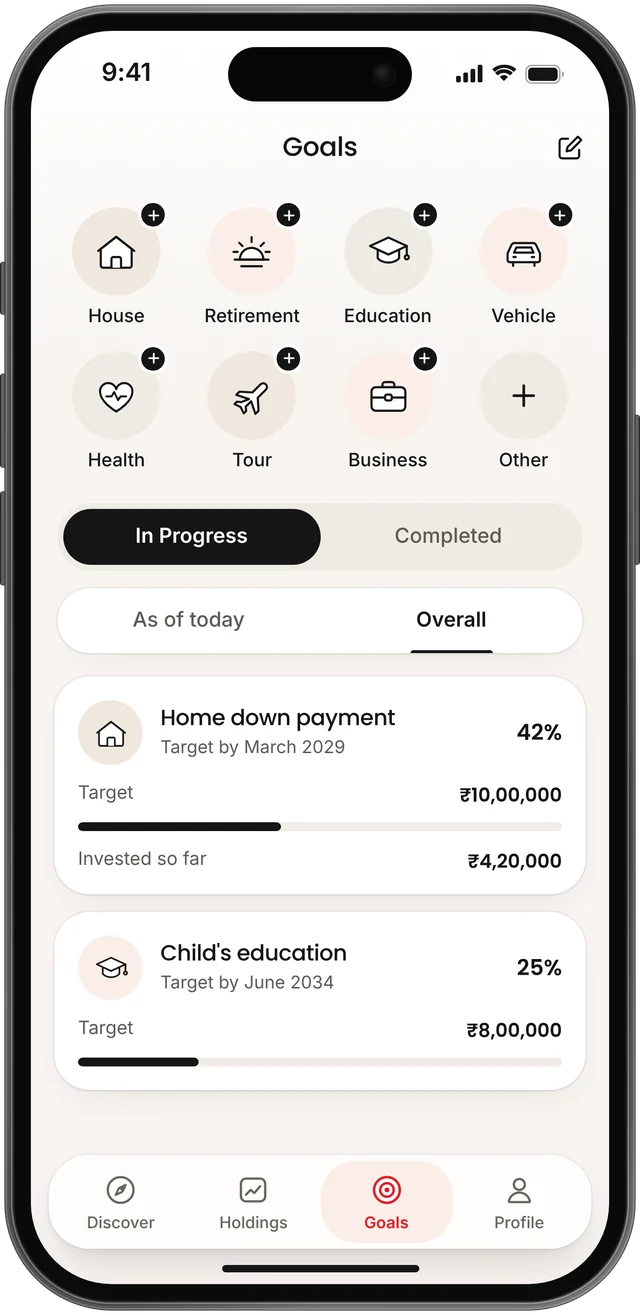
Goals in the Wealthier app link each investment to a target and a date, so that progress is easy to follow.
Insurance is not offered through Wealthier, so this part of the report is general education, and a licensed insurance intermediary can compare policies for your household.
Insurance is not offered through Wealthier, so this part of the report is general education, and a licensed insurance intermediary can compare policies for your household.
The Loans and EMI calculators in the Wealthier app, including Prepay Loan vs Invest, show how prepaying a loan changes monthly cash flow.
The retirement calculators in the Wealthier app show the effect of each assumption on the corpus needed at retirement.
The calculators for a systematic withdrawal plan (SWP) and a systematic transfer plan (STP) in the Wealthier app show how regular withdrawals affect a portfolio over time.
SIPs in the Wealthier app start from ₹100 a month in many schemes, and the Step Up SIP Calculator shows the effect of adding to the amount each year.
You can write to the Wealthier team with any question about this part of your report.
Bringing monthly outflows within income comes before a new SIP, and you can write to the Wealthier team with any question about your report.
International mutual fund schemes in the Wealthier app add companies listed in the US and other markets, subject to each scheme accepting fresh investments.
Theme collections in the Wealthier app group thematic mutual fund schemes around ideas such as artificial intelligence and space technology.
Gold schemes in the Wealthier app invest in gold, usually through gold exchange traded funds.
Mutual funds across equity, debt, hybrid, index and gold categories sit in one Wealthier account, so that new SIPs can adjust the mix gradually.
SIPs in the Wealthier app start from ₹100 a month in many schemes, which makes a first diversified SIP simple to begin.
Nominees can be registered on your Wealthier account after sign up, alongside every mutual fund holding.
Capital gains reports in the Wealthier app support the review before 31 March each year.
Mutual fund holdings, statements and reports sit together in one Wealthier account, which makes records easier for the family to find.
Import of mutual funds held elsewhere is launching soon and will let the whole portfolio be reviewed in one place.
Start an emergency fund goal Put surplus cash to work with a goal Set a retirement goal Map your investments to goals Write to the Wealthier team Explore the calculators Explore the calculators Explore the calculators Start a SIP Explore global investing Explore themes Add gold to the asset mix Adjust the mix with new SIPs Start a first SIP Add nominees after sign up See the capital gains reports Keep investments in one account